
GICT knowledge base
IPv4 vs IPv6: The Real Difference and the Shift to IPv6
Published
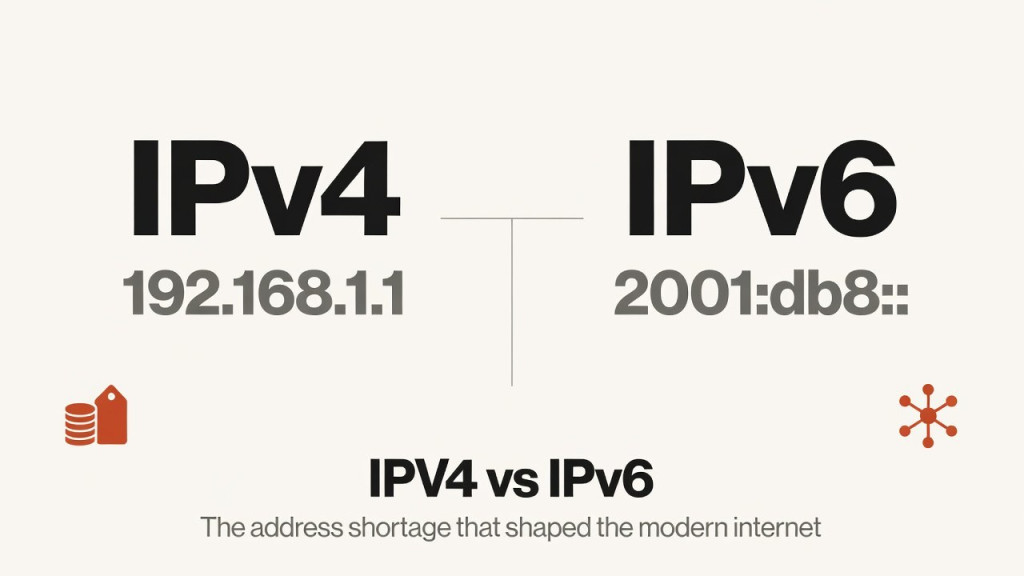
On February 3, 2011, the organization responsible for handing out internet addresses ran out of IP Addresses. All of them. The Internet Assigned Numbers Authority, which manages the global supply of IP addresses, allocated its last five blocks of addresses to regional registries and called it a day. The internet did not crash. Websites kept loading. Email kept flowing. Nothing dramatic happened at all, which is actually the most dramatic part of the story.
We have been living on borrowed time ever since.
The Day the Internet Ran Out of Street Addresses
Think of an IP address like a street address for your computer. Every device connected to the internet needs one to receive traffic. The system that powers most of that addressing is called IPv4, and it was designed in 1981 when the internet was a small research network and nobody imagined it would become the backbone of global commerce.
An IPv4 address is written as four numbers separated by periods: 192.168.1.1. Each number ranges from 0 to 255, which means it represents 8 bits of data. Four of them together give you 32 bits of address space. That works out to roughly 4.29 billion unique addresses. In 1981, when a typical computer took up an entire room and few people outside universities owned one, 4 billion sounded like more than humanity would ever need.
It was not.
The exhaustion timeline
The internet grew faster than anyone planned. Here is what the running-out process actually looked like:
February 2011   IANA global pool exhausted
April 2011      APNIC (Asia Pacific) exhausted
September 2012   RIPE NCC (Europe) exhausted
June 2014        LACNIC (Latin America) exhausted
September 2015    ARIN (North America) exhausted
March 2017       AFRINIC (Africa) exhausted
November 2019    RIPE NCC allocates its final /22 block
The reason nothing broke is that the industry had been building workarounds for years. Network Address Translation let hundreds of devices share a single public IP. CIDR and VLSM let providers split address space more efficiently. RFC1918 reserved large private ranges like 192.168.x.x and 10.x.x.x for internal networks where nobody needs a globally routable address.
IPv4 Became Something You Could Buy and Sell
When scarcity hit, a market formed. Microsoft bought 666,624 IPv4 addresses from bankrupt Canadian telecom company Nortel in April 2011 for $7.5 million. That works out to about $11 per address. At the time it seemed like a lot. In retrospect it was cheap.
Google purchased an entire /12 block in 2017. Amazon accumulated approximately 126 million addresses by 2022 through a combination of direct purchases and transfers, spending what analysts estimate at hundreds of millions of dollars. A /16 block contains 65,536 addresses. At peak 2021-2022 prices of $50 to $60 per address, a single /16 was worth over $3 million.
Today a single IPv4 address typically costs between $18 and $45 depending on block size and region. Leasing has emerged as an alternative: expect to pay $0.30 to $0.50 per address per month. That adds up. A /24 block with 256 addresses leased costs roughly $1,200 per year just for the addressing, before any compute or bandwidth charges. AWS added fuel to this fire in February 2024 by starting to charge $0.005 per IP per hour for all public IPv4 addresses in use. Your VPS has a recurring IP address bill now. This would have seemed absurd in 2000. In 2026 it is just part of the monthly invoice.
IPv6 Arrived 30 Years Ago and the Transition Is Still Not Done
The fix for all of this has existed since 1995. IPv6 uses 128-bit addresses instead of 32-bit ones. Where IPv4 gives you 4.29 billion addresses, IPv6 gives you 340 undecillion. That number is so large that writing it out takes longer than the internet has actually been around. The industry standard joke is that IPv6 gives you enough addresses to assign one to every atom on the surface of the Earth and still have room left over. The less funny version is that it gives you enough addresses that address exhaustion is genuinely, permanently solved for anything humanity is likely to build.
An IPv6 address looks different from what you are used to. It is written as eight groups of four hexadecimal digits separated by colons:
2001:0db8:85a3:0000:0000:8a2e:0370:7334
Two compression rules make this manageable.
- Rule one: drop leading zeros in each group.
- Rule two: compress one consecutive run of zero groups to double-colon. The address above shortens to:
2001:db8:85a3::8a2e:370:7334
The loopback address, equivalent to 127.0.0.1 in IPv4, is simply ::1. The unspecified address is ::. IPv6 addresses are always written in hexadecimal because decimal notation would require far more groups.
The Adoption
Despite all of this, the transition has been painfully slow. Google’s telemetry shows approximately 46% of its users connect over IPv6. That sounds like halfway there until you break it down by country. France sits at 86%. Germany and India are both around 68%. The United States is at 56%. Belgium, Peru, and Malaysia are all above 50%. China, which has the world’s largest internet population, is under 5%. Some African countries are below 1%.
The server side is worse. Research from February 2026 shows only about 35% of the top one million domains have AAAA records pointing to IPv6 addresses. Only 47% of mail servers accept IPv6 connections. These are services you would expect to be running on modern infrastructure. The problem is not just your ISP being slow. Server administrators have been disabling IPv6 on their machines for 15 years because of early compatibility bugs, and many never bothered to re-enable it.
There is a telling pattern in the data. IPv6 traffic to Google rises on weekends and drops on weekdays. This tells you the majority of IPv6 usage comes from residential and mobile networks, not enterprise ones. Your phone probably connects over IPv6 at home. Your office laptop probably does not. Business internet has been the slowest part of the transition, which is ironic given that businesses are the ones paying real money for IPv4 addresses.
What IPv6 Actually Changes
The address space number is the headline feature, but the real differences run deeper.
No more NAT
Every IPv6 device gets its own globally routable address. Your phone, your laptop, your smart thermostat all have unique addresses any server on the internet can reach directly. There is no NAT box doing translation. No port forwarding rules to configure. No reverse proxy just to serve multiple sites on one IP. The end-to-end principle the original internet was built on gets restored.
This matters for more than convenience. NAT creates state. A NAT device has to remember which internal IP sent traffic to which external IP and port so it can route the response back. That state is a bottleneck and a failure point. Peer-to-peer connections, which underpin video calls and gaming, work naturally on IPv6 because both sides have routable addresses.
Your device gives itself an address
IPv6 includes a mechanism called SLAAC, which stands for Stateless Address Autoconfiguration. When your device connects to a network, it listens for router advertisements. The router broadcasts what network prefix it manages. Your device generates its own host identifier and combines the two. The router does not need to track who has what address. Your device just picks one and verifies it is not already in use through a quick neighbor discovery probe.
This means you can plug two computers into a network with no DHCP server, no manual configuration, and no coordination. They will find each other and communicate. This is genuinely useful for small networks, temporary setups, and IoT devices where you do not want to run a DHCP service on every subnet.
What Still Does Not Work
The transition is real but incomplete in ways that matter.
IoT devices mostly do not support IPv6 in any useful way. A 2024 study found that only 8.6% of tested IoT devices continued functioning when placed on an IPv6-only network. The rest failed because they were designed around IPv4 NAT for address sharing and made assumptions about network architecture that do not hold on IPv6. The smart home revolution is mostly happening on IPv4 with NAT doing the heavy lifting.
China is the strangest case. It has 865 million IPv6 users, the most of any country, and the government has been pushing deployment hard since 2021. At the same time its adoption rate among major economies is one of the lowest because massive IPv4 infrastructure makes switching costly and disruptive. China built an entire internet on IPv4 and is now trying to move without breaking what works.
Corporate networks are the other stuck point. Many organizations disabled IPv6 during early testing because it broke internal applications. Fifteen years later those settings have never been revisited. The applications that caused problems are probably still running. Nobody wants to be the person who reenables IPv6 and discovers which critical system stops working.
Conclusion
Check what you actually have. Run ip addr show and ip -6 addr on your VPS. Your cloud provider almost certainly assigned you an IPv6 block when you provisioned the instance. The question is whether you are using it. Adding an AAAA record to your DNS takes minutes. Most users with IPv6 connectivity will automatically prefer it, and the Happy Eyeballs algorithm falls back to IPv4 within milliseconds if something does not respond.
If you build applications, test them over IPv6. Verify your database connections handle IPv6 addresses in your logs. Check that your monitoring tools parse both address formats correctly. IPv6-only bugs can hide for years because most of your users arrive over IPv4 until they do not.
The transition is not coming. It is already here, unevenly distributed. About half of all internet traffic is IPv6. Your phone is on it. Your cloud server probably supports it. Your corporate VPN probably does not. That gap between the parts that have moved on and the parts still waiting is where engineers spend their time when things break unexpectedly.
Related guides
How to Diagnose Packet Loss with mtr
Use mtr to investigate packet loss without misreading intermediate hops. Compare ICMP and TCP probes and collect useful evidence for hosting support.
NetworkingHow to Connect Two Servers Privately with WireGuard
Connect two servers with WireGuard and keep PostgreSQL on the tunnel. Verify peer traffic, private database access and denied public connections.
NetworkingEdge Computing for Web Apps: Cloudflare Workers vs Traditional Hosting
Edge computing for web apps in 2026: how Cloudflare Workers compares to traditional VPS hosting, when each wins, real cost numbers at different traffic levels, and a...
NetworkingAPI Security 101: Rate Limiting, Keys, and OAuth2 for Small Teams
API security for small teams in 2026: rate limiting strategies, API key best practices, when you actually need OAuth2, and a priority order for building it all out.