
GICT knowledge base
Directadmin Legacy Licenses
Published
The State of DirectAdmin Licenses: Legacy vs. Unified
In the past directadmin offered two code bases: Standard and Propack with additional features. Directadmin has changed its license structure and in the future only the pro pack will remain.
The New Standard
Today, if you buy a license, you get everything. The concept of “Pro Pack” is gone for new customers. The current lineup includes:
- Personal PLUS (2 accounts, 2 domains) – InterServer offers this at 3.75 /month in My.InterServer.net
- Lite (10 accounts, 50 domains)
- Standard (Unlimited)
Legacy licenses still exist however, and are available on some products, however the feature set is limited and these may stop working. Licenses that stop working must upgrade to personal plus.
Understanding the “Legacy” License
Any license type that isn’t one of the three listed above is now considered “Legacy.” DirectAdmin essentially split the road here. The new licenses run on a “Unified” codebase, while the old ones run on a “Legacy” codebase.
If you are on a legacy license there is no support by directadmin offered and the product is considered end of life. It is expected major security fixes will be applied.
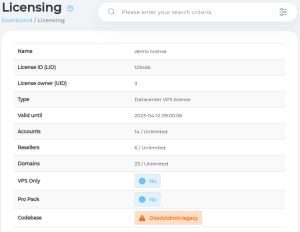
Even though the version number of your legacy build will go up in the changelog, that doesn’t mean you are getting the new features listed there. The legacy codebase is in maintenance mode, not development mode.
The “Hard Limits” of Staying Legacy
Why a paid license is recommended: It’s not just about missing a few buttons; it’s about the longevity of your operating system and database.
1. Operating System Upsets
This is the big one. Legacy licenses do not support the latest operating systems.
- Unsupported: Debian 13, Ubuntu 24, and RHEL 10.
- Supported (for now): AlmaLinux 8/9 and Ubuntu 22.
If you are running Ubuntu 22, you’re fine until April 2027. But after that, you cannot upgrade to Ubuntu 24 without changing your DirectAdmin license.
2. Database Limitations
You are also capped on your database version. Legacy licenses do not support MariaDB 10.11 or 11.x, nor MySQL 8.4.
The clock is ticking: If you are on MariaDB 10.6, its end of life 06 Jul 2026. After this enterprise upgrades from MariaDB are available as a paid option and will not be available in DirectAdmin. While MariaDB will function it will be end of life as well. Going to Pro Pack allows an update to move to MariaDB 10.11 or higher.
What Features Are You Missing?
Aside from the OS and Database limits, the “Pro Pack” features are stripped out of the legacy codebase. If you stick with a legacy license, you lose access to all of the following:
- Modern Language Support: No Python, Java, Ruby, Perl, or NodeJS (via Nginx Unit).
- Performance Tools: No per-user Redis manager, FastCGI cache support for WordPress, or per-user resource throttling (CPU/RAM/IO).
- Admin Tools: No Web Terminal, Git Manager, or DB Monitor.
- Security & Mail: No advanced Email Track & Trace.
- CMS: The WordPress Manager is not included.
The Bottom Line
There is currently no official “kill date” for legacy licenses, but they are a sunsetted product. They are great if you have a very specific, older setup that you don’t want to touch, but for any new deployment, they don’t make much sense.
Can you upgrade? Yes. Servers using legacy products can seamlessly upgrade to the Unified codebase just by applying a new license key.
Can you downgrade? No. Once you go Unified, you can’t go back to Legacy.
If you are confused about the changes, you aren’t alone. There has been plenty of discussion on the future of legacy holders and what the new system means over on the DirectAdmin forums. You can also read the official documentation here.
Our Recommendation:
To ensure your server stays secure and compatible with modern software, InterServer recommends moving to a current license type:
- Personal PLUS (Great for small personal VPS)
- Lite (Good for freelancers/agencies)
- Standard (The best choice for shared hosting providers)